


How We Help
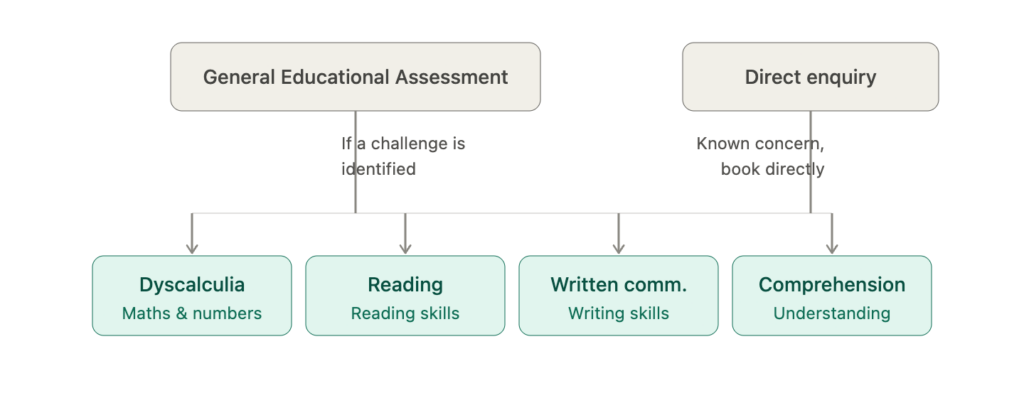
Alongside our General Educational Assessment, we run dedicated clinics for individuals experiencing difficulty in a particular academic area. You can book directly into one of these clinics if you already have a specific concern, or you may be referred through following a General Educational Assessment if an area of challenge is identified during that process.
Not sure where the difficulty lies? Start with a General Educational Assessment to help pinpoint the areas of concern.
Dyscalculia Clinic
For individuals experiencing persistent difficulty with numbers, mathematical reasoning, or calculation. This clinic assesses whether dyscalculia is present, how it is impacting the individual’s mathematical learning, and what strategies and supports will help build confidence and competence with numbers.
Reading Disorder Clinic
For individuals experiencing difficulty with reading accuracy, fluency, or decoding. This clinic assesses whether a specific reading disorder, such as dyslexia, is present and identifies the interventions and supports that will best help the individual read with greater confidence and ease.
Written Communication Disorder Clinic
For individuals experiencing difficulty with writing, spelling, or expressing ideas in written form. This clinic assesses whether a written communication disorder is present and provides tailored recommendations to support written expression at home, school, or work.
Comprehension Clinic
For individuals experiencing difficulty understanding or interpreting spoken or written language. This clinic assesses the nature of the comprehension challenge and identifies strategies to support understanding across learning and everyday contexts.
What’s Involved
- Parent/Client Interview (1 hour): A review of developmental history and current functioning.
- Optional Cognitive Assessment (2 hours): A standardised test measuring intellectual abilities, including verbal comprehension, processing speed, and working memory.
- Academic Assessment (3 hours): A standardised test of academic abilities, including comprehension, reading, oral language, written communication, and mathematics.
- Behavioural Questionnaires: Tools completed by parents, teachers, or the individual to provide additional insights into behaviour and functioning.
- Optional Educational Setting Observation (1 hour + travel): Observation of the individual in their learning or daily environment.
- Feedback Session (1 hour): A discussion of the assessment results, strengths, and recommendations.
- Comprehensive Report: A detailed, individualised report outlining the findings and strategies for home, school, or work.
Duration
The assessment is usually completed over five to eight questions.
Rebates
Medicare does not cover cognitive assessments. Contact your private health provider to check if rebates apply for this service.